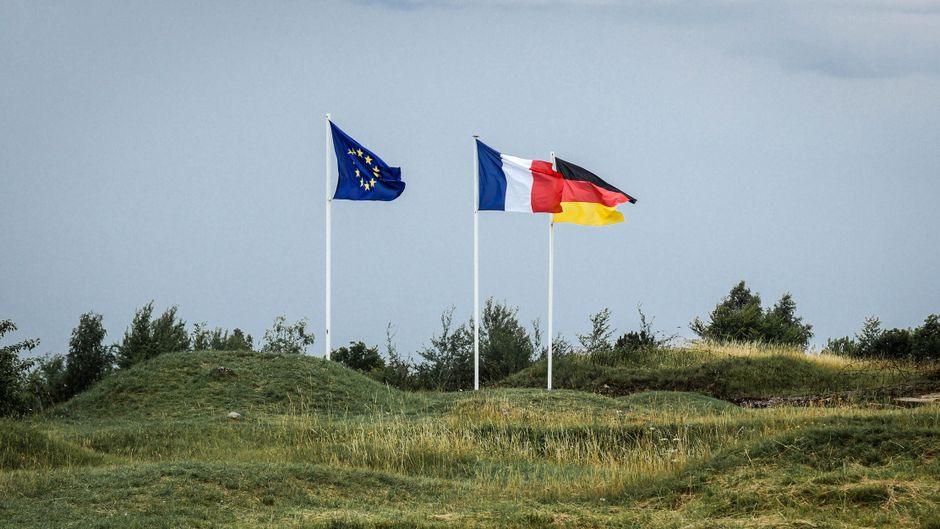
Macron and Merz Rally Franco-German Alliance Amid Shadow of 2027 French Election
French President Emmanuel Macron and German Chancellor Friedrich Merz have moved to reinvigorate the Franco-German partnership, announcing a sweeping set of shared commitments spanning defence cooperation, industrial policy and emerging technologies — a display of unity that carries an unmistakable political subtext as France’s 2027 presidential election draws closer.
The two leaders met with the stated aim of demonstrating that the bilateral relationship at the heart of European integration retains its capacity to drive the continent’s agenda, according to reports. Their joint push comes at a moment when the partnership has faced persistent questions about its coherence, and when the French political landscape is increasingly shaped by the rising influence of far-right leader Marine Le Pen.
A Partnership Under the Clock
Analysts and officials have noted that any agreements reached between Paris and Berlin carry an implicit expiration risk. Le Pen’s National Rally party continues to lead in several French polling indicators ahead of the 2027 contest, raising the prospect that a future French administration could reorient the country’s European posture significantly. That uncertainty lends urgency to the current efforts to lock in frameworks and deepen institutional ties before the political ground potentially shifts.
On defence, the two governments signalled a commitment to closer coordination on procurement and industrial capacity — an area where Franco-German friction has historically been pronounced. Officials pointed to the broader European security environment, shaped in large part by Russia’s ongoing war in Ukraine, as justification for accelerating collaboration rather than allowing divergent national priorities to stall progress.
The technology and industrial dimensions of the agenda reflected a shared concern about European competitiveness, particularly in relation to the United States and China. Both capitals have expressed frustration with the pace at which the European Union has moved to support strategic industries, and the bilateral declaration was framed in part as a prod toward faster collective action at the EU level, according to reports.
Merz, who took office earlier this year after leading his centre-right CDU/CSU bloc to victory in Germany’s federal elections, has made repairing and reactivating the Franco-German engine a stated priority. For Macron, who is constitutionally barred from seeking a third presidential term, the partnership offers a vehicle for consolidating his European legacy while he retains the authority to do so.
Whether the commitments announced will translate into durable policy or prove vulnerable to electoral disruption remains the central question hovering over the initiative. European partners and institutions will be watching closely to assess whether the Franco-German relationship can generate the momentum its architects are promising, or whether the looming uncertainties of the French electoral cycle will ultimately constrain its ambitions.