ECB holds deposit rate at 2% amid inflation and growth concerns
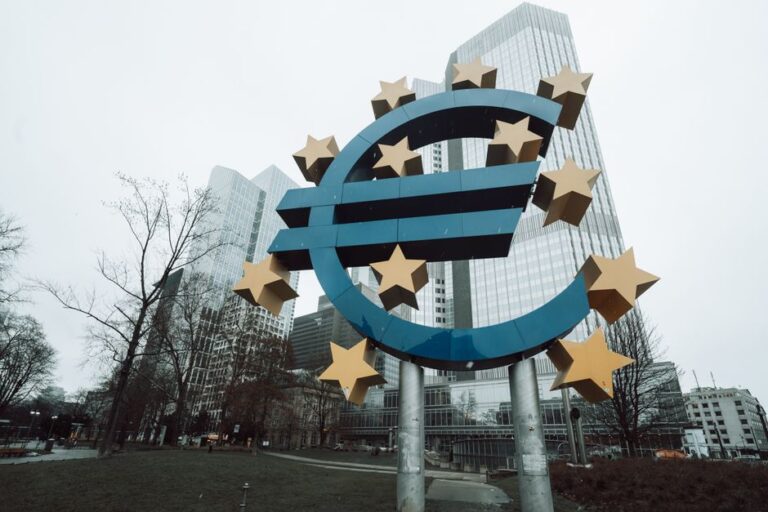
The European Central Bank held its three key interest rates unchanged on Thursday 30 April 2026 — the deposit facility rate at 2.00%, the main refinancing operations rate at 2.15%, and the marginal lending facility rate at 2.40%. It was the third consecutive meeting with rates on hold, after a series of cuts in 2024 and 2025 that brought the deposit rate down from a peak of 4% in September 2023. President Christine Lagarde, speaking at the Frankfurt press conference, framed the decision in unusually candid language about the geopolitical environment: “War, ceasefire, peace talks, their collapse, a naval blockade, its lifting, its reinstatement — makes it exceptionally hard to gauge the duration and depth of the consequences.”
The eurozone inflation surprise: 3.0% in April
The numbers driving the decision tell a coherent story of an economy absorbing a major external shock. Headline inflation rose to 3.0% in April, from 2.6% in March and just 1.9% in February. The trigger has been energy: energy price inflation jumped to 10.9% in April, after 5.1% in March, driven primarily by Brent crude prices that briefly surged above $126 per barrel in late April as the Strait of Hormuz situation worsened. Food price inflation edged up to 2.5% in April. Inflation excluding energy and food — the closely watched core measure — actually declined to 2.2%, from 2.3% in March, reflecting falling services inflation (3.0% from 3.2%) even as goods inflation rose to 0.8% from 0.5%. The pattern is classic supply shock: headline up, core relatively contained.
The growth picture: 0.8% Q1, slowdown confirmed
The eurozone’s first-quarter GDP grew 0.8% year-on-year, a slowdown from the late-2025 trajectory. The ECB’s March 2026 staff projections — incorporating information up to 11 March, days after the conflict broke out — see headline inflation averaging 2.6% in 2026, 2.0% in 2027 and 2.1% in 2028, all revised up from December. Real GDP is now projected to grow just 0.9% in 2026, 1.3% in 2027 and 1.4% in 2028, with the 2026 figure marking the largest downward revision among ECB scenarios since the pandemic. Lagarde was explicit on the downside risks: “The euro area economy was showing some momentum when the current turbulence started… due to the strong baseline before the conflict, the euro area economy has shown resilience but the war in the Middle East remains a downside risk.”
The hawkish dissent and the rate-hike scenario
The April decision masked a more divided debate than the unanimous vote suggested. According to Bloomberg‘s reporting and Lagarde’s own remarks at “The ECB and Its Watchers” conference in late March, policymakers debated a possible rate hike for the first time in this cycle. Lagarde said publicly: “If the shock gives rise to a large, though not-too-persistent, overshoot of our inflation target, some measured adjustment of policy could be warranted.” The ECB’s quarterly survey of professional forecasters, published on 4 May, now sees euro-zone inflation at 2.7% on average in 2026, revised significantly up from 1.8% in the previous round, with markets fully pricing in three ECB rate hikes during 2026, the first potentially as early as June. This is a complete reversal of the rate-cut path that consensus had previously seen.
The Savings and Investment Union as a structural answer
Beyond the rate question, Lagarde used the press conference to push hard on two structural files: the Savings and Investment Union, designed to deepen EU capital markets and channel European savings into productive investment, and the digital euro, the ECB’s retail central-bank digital currency project. Both, she argued, would “help simplify the fiscal landscape across the bloc and boost capital flows.” She also flagged Russia’s full-scale invasion of Ukraine and the risk of further trade tensions — particularly with the United States under the Trump administration — as additional headwinds the ECB is watching closely. Vice-President Luis de Guindos, in a speech at the joint Commission-ECB conference on European Financial Integration, framed deeper financial integration as “a future of shared prosperity and resilience.”
The bank reserves question
One of the most technical but consequential lines of questioning at the press conference concerned liquidity. Euro area central bank reserves have nearly halved from the peak in 2022 to €2.6 trillion in early 2026, and the latest bank lending survey found that bank access to money market funding has deteriorated. Asked whether the Governing Council had been considering new structural longer-term credit operations or a structural portfolio of securities, Lagarde was non-committal but signalled active internal review. The unwinding of pandemic-era quantitative easing is now interacting with a new tightening of liquidity conditions caused by the conflict — a combination that could resurface as a financial stability issue if the Iran war continues into the second half of 2026.
The next meeting: 18 June
The Governing Council’s next monetary policy meeting concludes on Thursday 18 June 2026, with new staff projections incorporating fresh data on energy, wages and the conflict’s macroeconomic impact. Lagarde concluded: “We believe that in six weeks we will be able to make a more informed decision, either because the conflict will have an outcome or the consequences will be clearer.” Markets are positioning for one of three scenarios: a hold accompanied by a hawkish lean, a 25-basis-point hike, or — in the event of a Middle East ceasefire — a continuation of the wait-and-see pause. The same week sees the publication of the ECB’s June 2026 Monetary Policy Report and the ECB’s annual conference on financial stability. The euro itself, trading at around 1.13-1.17 against the dollar, will move sharply on the result.