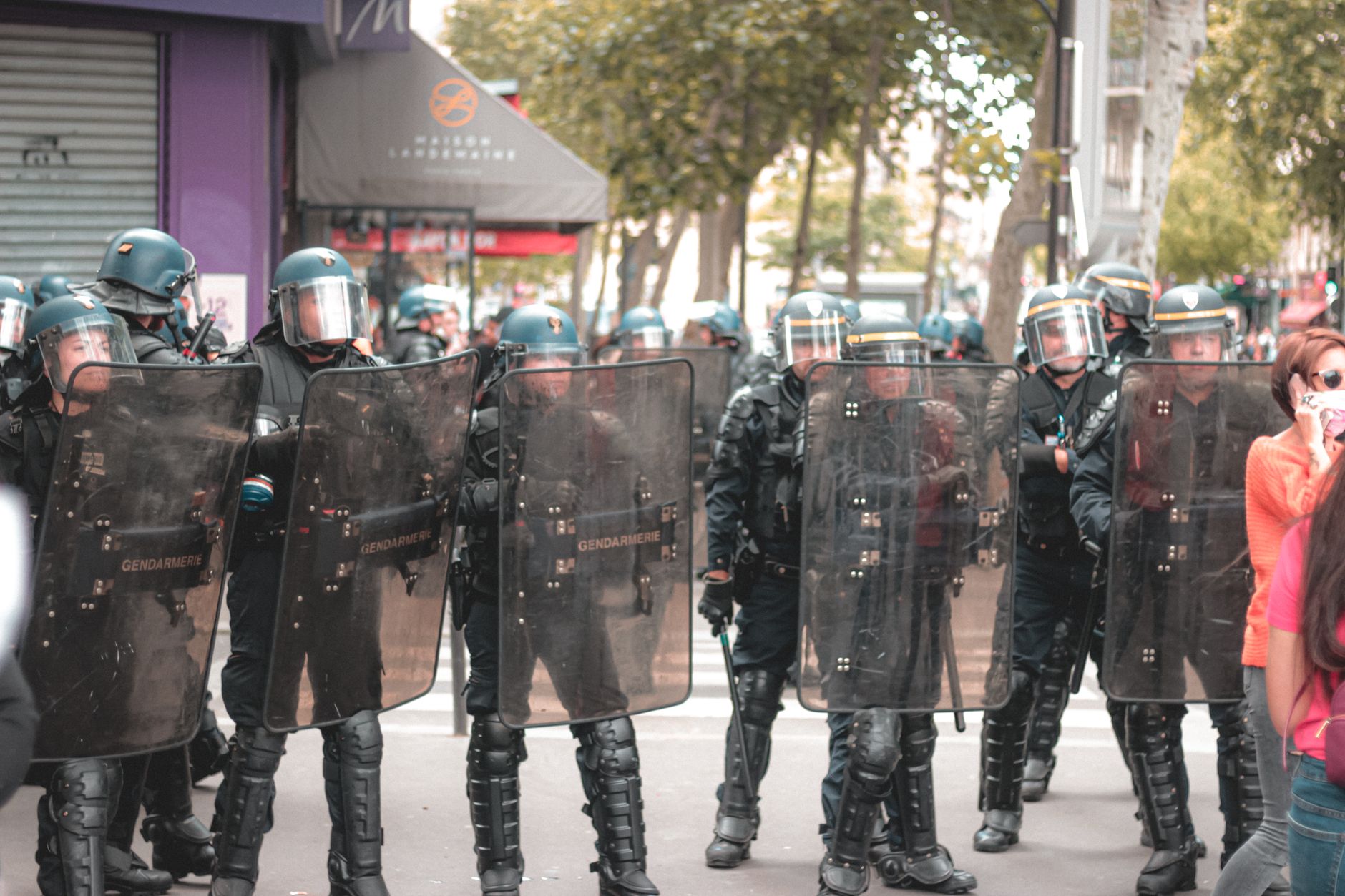
French Police Face Renewed Scrutiny Over Protest Tactics and Injuries
Recent weeks of protests across France have reignited a long-running debate about the methods and equipment used by the country’s police forces. Viral videos allegedly showing officers beating a man to the ground, dragging an unconscious person away, and grabbing a young man by the neck have circulated widely on social media, though they have not been independently verified. Rights groups have renewed criticism of French police tactics, particularly their use of stun grenades and rubber bullets, which they say cause severe injuries.
Student protests over the past weeks have resulted in several teenagers suffering life-changing injuries, including one who lost a hand, another who was blinded in one eye, and a third whose jaw was broken. More than half a million people took to the streets on Saturday, most of them peacefully, to protest public sector cuts and the cost-of-living crisis, and to support students’ demands for better classroom conditions. However, some rioters burned buildings, looted stores, and threw projectiles at police, creating a difficult situation for officers and other emergency services.
Heavy Arsenal and Unique Tactics
France’s police are among the most heavily armed in Europe, with a bigger arsenal than most of their counterparts in other EU countries. Officers routinely use the LBD-40, a gun that fires rubber bullets, while police in the UK and Germany mostly do not allow such weapons in protests. Spain sometimes uses rubber bullets but with fewer injuries than France. French police also stand out for their use of stun grenades, which, according to Anastassia Tsoukala, associate professor of criminology at the University of Paris-Sud, contain a high level of explosive substances. “From this point of view, France is unique,” she told DW.
Tsoukala noted that the use of rubber bullets is not a French specificity, but that guidelines require a certain distance. “Even if you try to respect the guidelines, people may move and then all of a sudden they may lose one eye,” she said. “So it’s extremely dangerous.” Interior Minister Laurent Nunez has insisted that police weapons are non-lethal, though some equipment is classified by France’s internal security code as war material. The teenager who lost the use of an eye was suspected of being hit at close range by a rubber bullet from an LBD-40.
International Comparisons and Human Rights Concerns
Sebastian Roche, a researcher at France’s National Centre for Scientific Research who specializes in comparing police forces across Europe, offered a stark assessment. “When we look at crowd control, it is clear that if we measure police brutality by the number of deaths amongst demonstrators or members of the crowd, and if we also measure it by the number of cases of maiming, the French police are the most brutal in the whole of the European Union,” he said. Roche compared environmental protests in Lützerath, Germany, in 2023 with those in Sainte-Soline, France, the same year. In Lützerath, dogs were used and there were some injuries, but far fewer serious injuries on both sides. In Sainte-Soline, military police were sent in, LBDs and grenades were used intensively, and serious injuries occurred on both sides, with two protesters left in a coma.
UN international standards state that the use of force should be exceptional, used for the prevention of crime or lawful arrest, and follow the principle of proportionality. While proportionality is enshrined in French law, and Nunez has said officers largely respected this principle during the current protests, Amnesty International has described the police response as disproportionate and called on French authorities to act upon their human rights obligations. The French branch of the League of Human Rights has condemned the “violent repression” of the high school protest movement.
Accountability and Oversight
France has no independent police watchdog; internal investigations are handled by the General Inspectorate of the National Police (IGPN), which has opened at least 40 cases since the beginning of the latest protests. In contrast, the UK and Denmark investigate incidents with independent watchdogs. Tsoukala criticized the leniency and lack of transparency across Europe in police incident cases, noting that officers are often acquitted or receive extremely light penalties. “And I’m afraid this is the standard method to deal with police brutality cases across Europe,” she said.
Nunez acknowledged the difficulty of the situation, saying it was very complicated to contain all the different groups, but praised the police for doing a great job and preventing a great number of crimes. Tsoukala, however, stressed that public order is subordinated to human life and safety, which as a jurist she considers a non-negotiable value. The French government has said it will deploy military forces for upcoming protests this weekend, as the debate over police tactics continues.